
Same Joomla Page, 80% Fewer Tokens: Serve Markdown to ChatGPT

Ask ChatGPT, Claude, or any AI tool out there about something your site covers better than anyone, and it might answer without ever pulling from your page. Often, the reason has nothing to do with your writing.
When an AI reads your page, it takes in the raw HTML: menus, sidebars, cookie banners, ads, and a pile of tags, and it pays for every byte in tokens. By the time it reaches your actual words, most of its budget is gone, and your key paragraph can come through garbled or skipped.
The same page in clean Markdown is about 80% smaller. This post explains why HTML costs AI so much, and how serving a Markdown copy of your Joomla pages gives ChatGPT and other AI agents a version it can read without wading through your template.
What's the Problem With HTML?
There's nothing wrong with HTML. AI tools are clever enough to read your pages just fine. The trouble is what it costs them. Your words sit wrapped in menus, sidebars, scripts, and nested tags, and a model has to chew through all of it, paying in tokens, before it reaches the part that matters.
That cost is exactly what the big players are routing around. Cloudflare announced Markdown for Agents, a feature that automatically converts HTML to Markdown at the edge when AI agents request it. This year, Stripe and GitHub started serving plain Markdown copies of their developer docs: append .md to a Stripe docs page and you get the stripped-down version, and GitHub does the same for its own pages. The same is happening in the CMS world: Joost de Valk, the founder of Yoast, the most popular WordPress SEO plugin, built Markdown Alternate, which gives every WordPress post and page its own .md version with the same content negotiation and discovery links.
The gap is wider than you'd guess. Take this very page: in raw HTML it weighs in at 20,347 tokens, and just 3,270 once converted to Markdown, an 84% reduction. That's the whole problem in a single number.
| Format | Characters | Tokens | Size vs HTML |
|---|---|---|---|
| HTML (full page) | 64,131 | 20,347 | — |
| Markdown (.md) | 13,078 | 3,270 | 84% smaller |
Every AI model reads text in tokens, and it has a fixed budget per request. When 80% of your page is template chrome (the header, the menu, the cookie banner, inline CSS, tracking scripts), the model burns most of its budget on things unrelated to your content.
Worse, the noise confuses it. The model has to guess which <div> holds your article and which holds an ad. Sometimes it guesses wrong, and your key paragraph gets ignored or garbled.
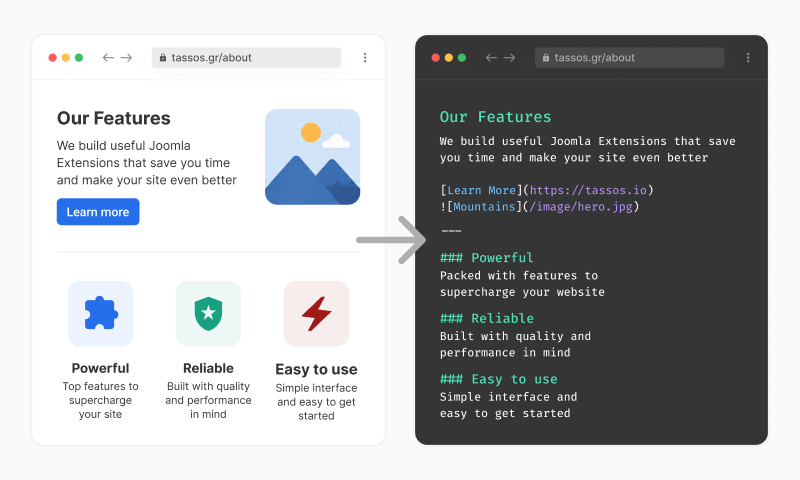
Markdown strips all of that away. A heading is #, a list is a dash, a link is in brackets. No wrapper, no clutter. The model gets pure structure and pure content, which is exactly the format it was trained on.
What Does "HTML to Markdown" Actually Mean for AI?
Markdown is the format LLMs handle most efficiently. The proposal to serve Markdown versions of web pages, called llms.txt, was published in September 2024 by Jeremy Howard, the founder of Fast.ai (Ahrefs, What Is llms.txt, June 2026). The core idea was simple: give AI a clean copy of your page by appending .md to the URL.
Think of it like serving two versions of the same article. Humans get the full HTML page with your design, your menu, and your branding. AI agents get a stripped-back Markdown twin that says the same thing in a fifth of the space.
The handoff happens through something called content negotiation, which is a normal part of how the web already works. An AI agent sends a request that says, "I'd prefer Markdown, please", and your site hands back the Markdown version. A regular visitor's browser asks for HTML and gets the usual page. Nobody sees a difference. The AI just gets a cleaner read.
According to Cloudflare's 2026 rollout of the same idea, agents request Markdown by sending an Accept: text/markdown header, and the response exposes the savings in x-markdown-tokens and x-original-tokens headers. The mechanism is now a recognized pattern, not a fringe experiment.
Convert Joomla Pages to Markdown Automatically
If you'd like to get ahead of this, you'll want clean, Joomla-aware Markdown pages on dedicated .md URLs that help AI tools read your content properly. That's exactly what Google Structured Data does. We recently added HTML-to-Markdown conversion to Google Structured Data, and it's a single toggle, no code required.
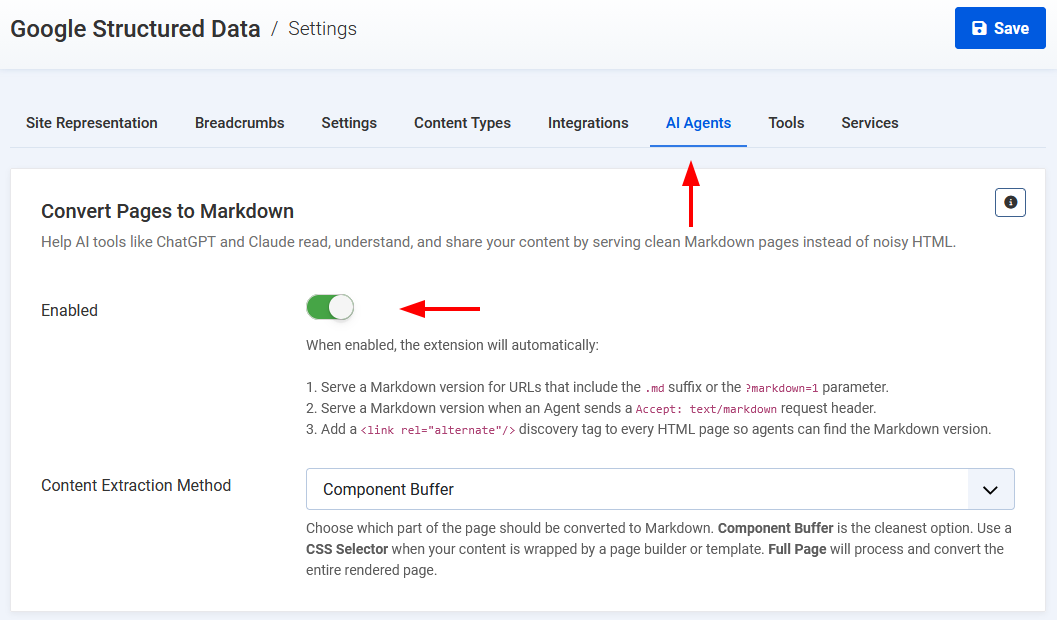
Here's what that one toggle gives you:
Dedicated .md URLs
Every page answers at its own Markdown address: append .md to any URL, so /my-article also serves /my-article.md (with Joomla's SEF URLs on). Agents that prefer headers can send an Accept: text/markdown request and get the same content at the normal URL, and ?markdown=1 works as a quick manual test.
Discoverability
Google Structured Data injects a <link rel="alternate" type="text/markdown"> tag into your page's <head>, so AI agents find the Markdown version on their own instead of guessing. You get real, shareable .md URLs, where a header-only approach stays invisible.
Richer metadata
Each Markdown page opens with a YAML frontmatter block: title, description, canonical URL, publish date, and language. Your full JSON-LD schema is appended as a code block, so an agent gets your content and a machine-readable map of the page in one file, not just stripped text.
Joomla-aware content processing
A generic CDN converter sees a wall of HTML and guesses where your article ends and the template begins. Google Structured Data starts from inside Joomla, so it knows exactly which part is your content, strips the template chrome, and rewrites relative links as absolute.
The HTML to Markdown documentation explains every setting.
Doesn't Google Say This Is Pointless?
Fair challenge. Search engineers at Google and Bing have pushed back hard on the idea of building bot-only Markdown pages, and they're right about the part that matters most: this won't lift your Google rankings. We're not claiming it will. If you came here hoping a Markdown twin moves you up the results page, it won't, and anyone selling it that way is wrong.
Most of that criticism targets two things this feature isn't. The first is Markdown as an SEO ranking signal, which it was never meant to be. The second is llms.txt, a separate index file you publish and hope bots read. We just covered why that one rarely gets fetched.
What's left is a narrower, mechanical claim. When an AI agent actually requests your page, it gets a version that's roughly 80% smaller and free of template clutter. This won't make AI start recommending you. Whether an assistant cites you depends on far more than file format: your content, your authority, and how well you answer the question. What Markdown changes is the reading itself. When a bot does fetch you, it gets your real words cleanly instead of digging them out of template clutter. That's the honest benefit, at a cost of one toggle.
The "double crawl load" worry doesn't apply here either. The Markdown twin carries an X-Robots-Tag: noindex, nofollow header and a canonical link back to your HTML page, so search engines won't index it or weigh it as duplicate content. When an agent uses content negotiation, it's the same URL serving a lighter response, not a second page to crawl.
Should You Turn It On?
Honestly, we're all still figuring out how AI agents work. It's a vague, fast-moving space. What we do know is this: agents can already read your HTML, but they burn a lot of tokens doing it. So when one shows up and explicitly asks for Markdown, why not hand it over?
And if AI agents end up really needing Markdown a few months from now, you're already set. It won't hurt your site either way. Sure, it won't lift your Google rankings or get your company named in an assistant's recommendations. But it's one toggle, it costs you nothing, and it's worth a try.
Turn on Convert Pages to Markdown in Google Structured Data and see what an AI sees.
Featured Articles



 Rated: