

-
-
- Submit Updated Articles to Bing and Yandex with IndexNow in Joomla
- Add Published and Modified Date Meta Tags to Joomla
- Add Open Graph and Twitter Card Tags to Joomla
- Auto-Generate Meta Descriptions from Article Text in Joomla
- Add Noindex to Specific Pages in Joomla
- Verify Your Joomla Site with Google Search Console
-
- Add a View as Markdown Link to Joomla Articles
- Display the Last Modified Date in Joomla Articles
- Embed Iframes in Joomla
- Automatically Link Twitter (X) @mentions in Joomla Articles
- Open External Links in a New Tab in Joomla
- Display Estimated Reading Time in Joomla Articles
- Replace Old URLs in Joomla
- Search and Replace in Joomla
-
- Add a Footer Line to the Joomla Administrator
- Show a Staging Banner in the Joomla Administrator
- Remove the "All" Option from Admin List Limits in Joomla
- Add a Cookie Consent Banner to Joomla
- Make the Administrator Navigation Sticky in Joomla
- Add Google Fonts to Joomla
- Add a Facebook Messenger Chat Button to Joomla
- Add a Reading Progress Bar to Joomla
- Add a Custom Scrollbar to Joomla
- Show Confetti on a Thank You Page in Joomla
- Add Smooth Scrolling to Joomla
- Add a Back to Top Button in Joomla
- Add a WhatsApp Chat Button in Joomla
-
- Protect the Administrator with a Secret URL Key in Joomla
- Show a Welcome Message on First Login in Joomla
- Log Out Idle Administrators in Joomla
- Assign New Users to a Different User Group Automatically in Joomla
- Redirect Visitors by Country in Joomla
- Redirect Users After Login by User Group in Joomla
- Block User Registration with Certain Usernames in Joomla
- Block User Registration by Country in Joomla
- Block User Registration by Email Address in Joomla
- Block User Registration by IP Address in Joomla
- Remove the Forgot Password and Username Links in Joomla
- Remove the Generator Meta Tag in Joomla
- Let Users Log In with Their Email Address in Joomla
- Block Traffic by Country in Joomla
- Block Bot Traffic in Joomla
- Block Traffic by IP Address in Joomla
Add PostHog to Joomla
See where visitors drop off and what they do before they leave by adding PostHog product analytics to Joomla, using one HTML snippet.
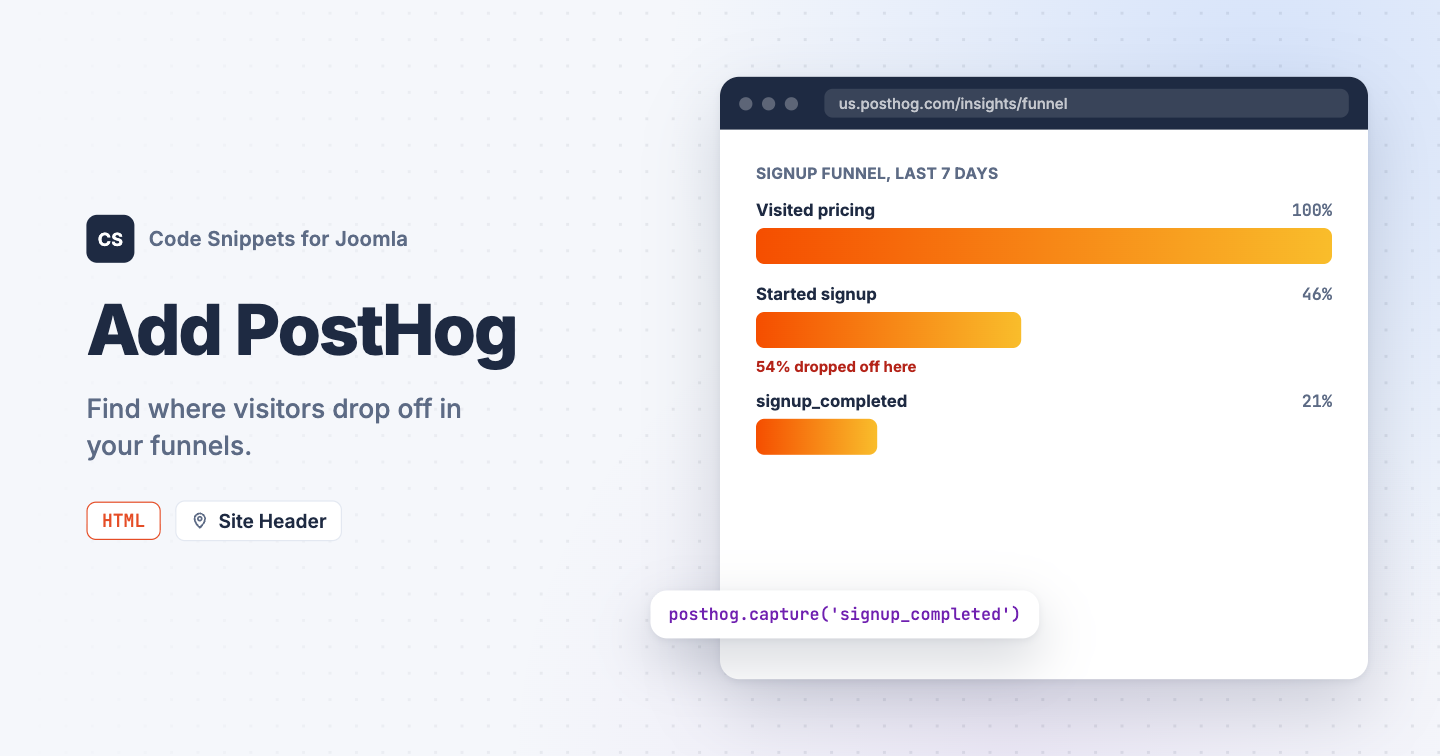
Your page view counter says 400 people visited your pricing page yesterday, and that's all it can tell you. You still don't know where visitors gave up in your signup flow, which button visitors ignore, or what someone did right before leaving. PostHog answers those questions with funnels, session recordings and heatmaps. You can add PostHog to Joomla with one HTML snippet in Code Snippets.
Get your snippet
You need a PostHog account, on PostHog Cloud or your own server.
- Sign in to PostHog, or create an account and a project.
- Open your project settings.
- Copy the web snippet. It already holds your project token and your host, like
https://us.i.posthog.comorhttps://eu.i.posthog.com.
The snippet code
Use the snippet exactly as PostHog gives it. It's one long script that ends with posthog.init('...', { api_host: '...' }). In the Site Header location it lands in the <head> of every page, and PostHog starts counting page views.
How to add this snippet
- Install Code Snippets if it isn't installed already.
- Log into your Joomla backend.
- Go to Components → Tassos Code Snippets.
- Click New.
- Enter a title, for example PostHog.
- Set Code Type to HTML.
- Set Insertion Method to Auto-Insert Locations.
- Set Location to Site Header.
- Paste your PostHog snippet into the editor.
- Click Save & Close.
Track a custom event
To count a specific action, like a completed signup, add a second snippet that runs only on the page visitors see afterwards:
posthog.capture('signup_completed', {
    plan: 'pro'
});- Click New.
- Enter a title, for example PostHog signup event.
- Set Code Type to JavaScript.
- Set Insertion Method to Auto-Insert Locations.
- Set Location to Site Footer.
- Paste the code above into the editor.
- Change
signup_completedand its properties to suit your event. -
Open the Conditional Logic tab:
- Set Display on to Selected Pages.
- Click New Condition Set.
- Click Select Condition and choose URL - Query String.
- In URL, enter a part of your thank you page's address, for example
thank-you.
- Click Save & Close.
Check that it works
- Open your site in a normal browser window with no ad blocker.
- In PostHog, open Activity.
Your page view shows up within seconds, and your custom event when you reach that page. If nothing arrives, check that the snippet is published and that its host matches your project's region. PostHog skips visits from bots and automated browsers.
For free session recordings and heatmaps, see Add Microsoft Clarity to Joomla. To learn more, read the HTML snippet docs and the JavaScript snippet docs.




 Rated: