

-
- Managing Form Submissions
- Searching and Filtering Submissions
- Display Form Submissions on the Front-End
- Submission Context Tracking
- Customizing Submission Columns
- Editing Submissions
- Deleting Submissions
- Importing Submissions
- Exporting Submissions
- Exporting Submissions with a Webhook URL
- Tracking the User's IP Address
- Tracking the User's Country
- Disable Submission Storage
- Auto-Delete Old Submissions
- Auto-Save Each Submission to a JSON file
- Increment a Count on Each Submission
- Add a Unique ID to Each Submission
-
- Checkboxes
- Color Picker
- Confirmation
- Country
- Currency
- Date & Time
- Dropdown
- Email Address Field
- File Upload
- Hidden Field
- Icon element
- Number
- Page Counter element
- Password
- Phone Number
- Radio & Checkbox Images
- Radio Buttons
- Range Slider
- Rating
- Rich Text Editor
- Signature
- Terms of Service
- Textarea
- Textbox
- Website / URL Field
-
- Email the Person Who Filled Out the Form
- Send an Email Only When a Checkbox Is Checked
- Attach the Submission PDF to Emails
- Send Email Based on Drop Down Selection
- Send Different Email Content Based on Form Responses
- Set up Auto-Responder Emails
- Styling Emails with CSS
- Sending Plain-Text Alternative Body Emails
- Troubleshooting Email Delivery
- Tracking Sent Emails
- Resending Emails
-
- Browser Autocomplete for Form Fields
- Customizing Submission Date Created and Modified Formats
- How to Create a Quiz Form
- Centering forms
- Show Confirmation Popup After Submission
- Redirect to a Menu Item After Form Submission
- Use custom Google Font in your form
- Embed a Form in an External Website
- Copy Value From One Field to Another
- Add Placeholder Text to Fields
- Show a Form Only to Logged-In Users
- Add Custom CSS
- Adding an “Other” Option
- Show or Hide Form Fields Based on User Joomla User Group
- Scroll the Page to the Top When a Long Form is Submitted
- Populate Fields Using Query String
- Display Submissions Count for a Specific Form
- Populate Drop Down, Radio Buttons or Checkboxes with a CSV File
- Silently POST Submitted Data to Any API or URL
- Create a Custom Login Form
- Auto-Populate Fields with Article Data
- Add a placeholder text to a Dropdown field
- Create Multilingual Forms in Joomla
- Redirect User to a URL After Form Submission
- Importing and Exporting Forms
- Display Convert Forms in a popup
-
- CSRF Token
- Does Convert Forms Use Cookies?
- Minimum Time to Submit
- Restrict Form Submissions Based on IP
- Enforcing a Custom Password Policy in Convert Forms
- Add ALTCHA Proof of Work to your Joomla form
- Add Cloudflare Turnstile to your Joomla Form
- Implement the Iubenda Consent Database in Joomla with Convert Forms
- Add Custom Validations to Fields and Forms
- Add Math Captcha to your Form
- Prevent a Field From Saving in the Database
- Add hCaptcha to your Form
- Enable Double Opt-in
- Allow Form Submissions in Specific Date Range
- Ensure a Unique Value is Entered Into a Field
- Block Form Submissions Containing Profanity (Bad Words)
- Block Email Addresses or Email Domains
- Honeypot
- Setting Up Google reCAPTCHA
- Create GDPR Compliant Forms
-
- Troubleshooting Spam Submissions
- Updating from Convert Forms 5 to 6
- Troubleshooting Form Submission Errors
- Troubleshooting Form Rendering Issues with Joomla Cache
- Frequently Asked Questions
- Troubleshooting Issues with the Joomla Email Cloak Plugin
- Campaigns Feature Is Deprecated: Migrate to Tasks
- Prevent Form from Getting Covered by a Sticky Menu Bar
- Troubleshooting Convert Forms
Create a PayPal Joomla Form
Convert Forms can send your visitors to PayPal right after they submit a form, with the amount and the details they entered, so you can sell products or collect donations. Start from one of the two PayPal templates, or add the PayPal fields to any form yourself.
How to create a PayPal payment form
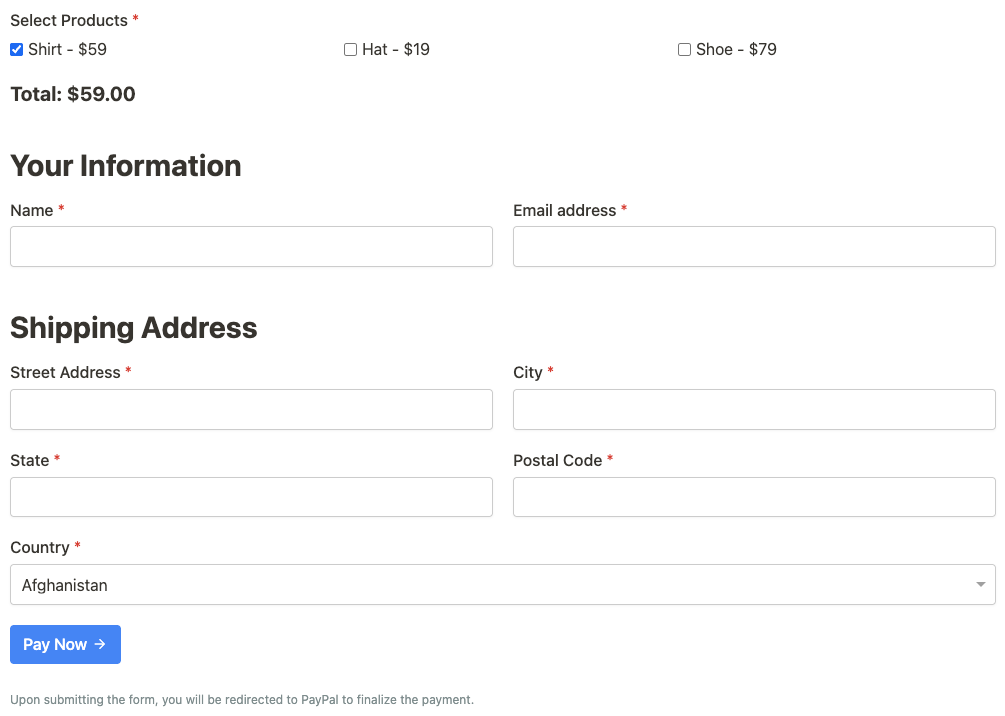
The PayPal Payment Form template lists three sample products with a live total, asks for the buyer's details and shipping address, and sends the buyer to PayPal to pay.
- Log into your Joomla backend.
- Go to Components → Convert Forms → Forms.
- Click New.
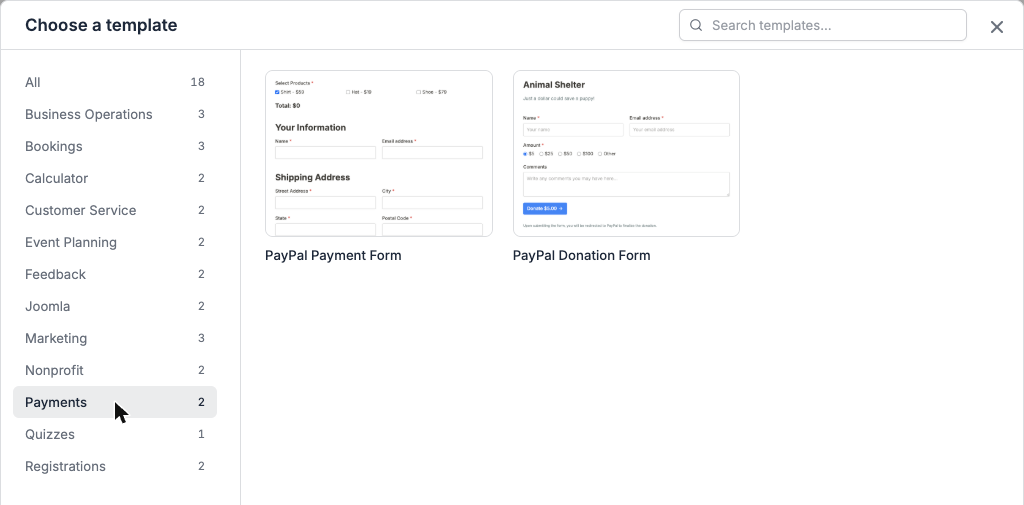
- In Choose a template, click the Payments category.
- Click PayPal Payment Form. The form opens in the builder.
Before you publish the form, change these elements. Click an element in the list on the left to see its settings.
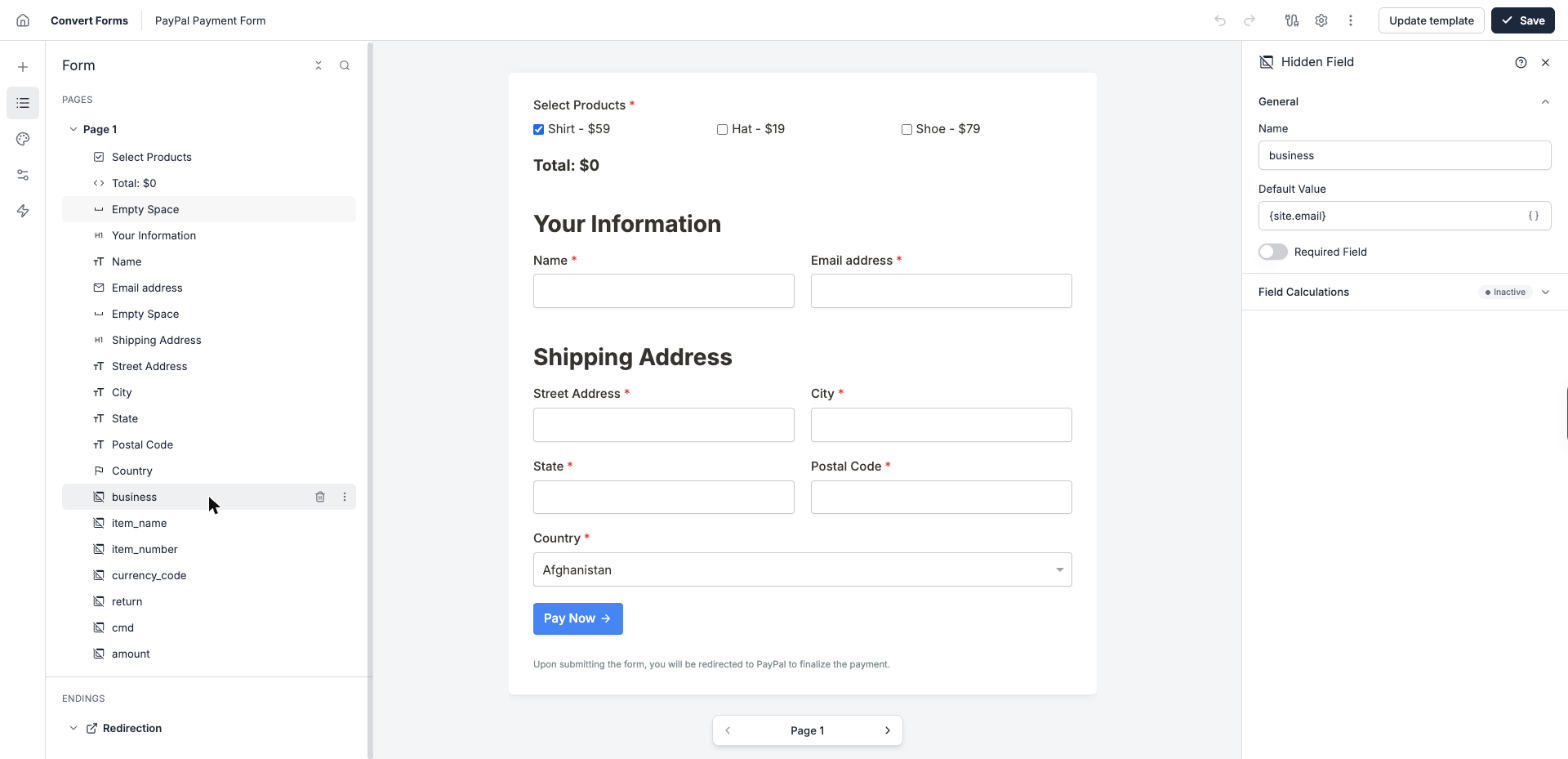
| Element | What to change |
|---|---|
| business | Replace {site.email} in Default Value with the email address of your PayPal business account. |
| Select Products | Enter your own products. Each choice's value is its price, and the total adds up the values of the ticked products. |
| item_name | Enter the name buyers see on PayPal for this purchase. |
| item_number | Optional. Enter an ID or SKU for the purchase. PayPal passes it back to you as is. |
| currency_code | Enter your currency code. See PayPal's currency codes. If you change it, also change the $ sign in the product labels and in Total. |
| return | Enter the page buyers return to after they pay. It's your site's home page by default. |
How to create a PayPal donation form
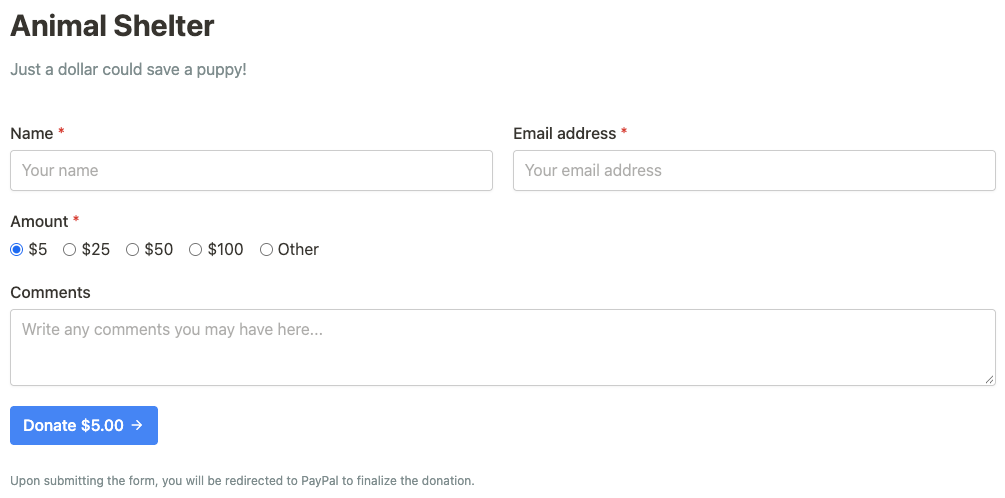
The PayPal Donation Form template lets donors pick $5, $25, $50, $100 or their own amount, and sends them to PayPal to donate. The Donate button always shows the amount they picked.
- Log into your Joomla backend.
- Go to Components → Convert Forms → Forms.
- Click New.
- In Choose a template, click the Payments category.
- Click PayPal Donation Form. The form opens in the builder.
Before you publish the form, change these elements:
| Element | What to change |
|---|---|
| business | Replace {site.email} in Default Value with the email address of your PayPal business account. |
| currency_code | Enter your currency code. See PayPal's currency codes. If you change it, also change the $ sign in the Amount choices and in the Donate button text. |
How to create a PayPal form manually
To create a PayPal form, whether it's for selling goods or services, or accepting donations, go to Components → Convert Forms → Forms and click New, or edit an existing form. Then add the fields below. Your PayPal form needs all of them to work.
Decide on your Payment Type
Your Payment can be one of the following:
- Receive donations
- Sell products
- Sell subscriptions
If you are receiving donations, you will need to add the following field:
| Field Type | Field Name | Field Value |
|---|---|---|
| Hidden | cmd | _donations |
If you are selling products, you will need to add the following field:
| Field Type | Field Name | Field Value |
|---|---|---|
| Hidden | cmd | _xclick |
If you are selling subscriptions, you will need to add the following fields:
| Field Type | Field Name | Field Value |
|---|---|---|
| Hidden | cmd | _xclick-subscriptions |
| Hidden | no_note | 1 |
| Hidden | a3 | The subscription's price |
| Hidden | p3 | The length of the billing cycle |
| Hidden | t3 |
The units of the billing cycle. Acceptable values are:
|
| Hidden | src |
If set to "1", the payment will recur unless your customer cancels the subscription before the end of the billing cycle. If omitted, the subscription payment will not recur at the end of the billing cycle |
| Hidden | sra |
If set to "1" and the payment fails, the payment will be reattempted two more times. After the third failure, the subscription will be cancelled. If omitted and the payment fails, payment will not be reattempted and the subscription will be immediately cancelled |
The p3 and t3 fields can be used to control the billing frequency of your subscription. For example, if p3 is set to 1 and t3 to M, then the subscriber will be billed once every month.
After deciding on the Payment Type field, you can now add the fields that say who will receive the payment, the item name that describes what your users will be paying for, the amount of items your user will be buying as well as the amount of the payment, currency and an item image.
| Field Type | Field Name | Field Value |
|---|---|---|
| Number or Textbox | amount |
E.g.: 5 (you can omit this field if you're setting up a subscription form) |
| Hidden | business | Your PayPal Business Email Address |
| Hidden | item_name | My Item Name |
| Hidden | item_number | 1 |
| Hidden | image_url | Image URL of Item |
| Hidden | currency_code | USD |
To return your users to a specific page after they have successfully made a transaction, you will need to add the following field in your form:
| Field Type | Field Name | Field Value |
|---|---|---|
| Hidden | return | URL of a page on your site where users will be redirected once they make a transaction |
Note: You will need to enable Auto Return on your PayPal account page. Read more here: How do I use PayPal's Auto Return feature to redirect customers back to my website?
To return your users to a specific page after they have cancelled a payment, you will need to add the following field in your form:
| Field Type | Field Name | Field Value |
|---|---|---|
| Hidden | cancel_return | URL of a page on your site where users will be redirected after they have cancelled a payment |
Shipping cost
To set a shipping cost, create the following field in your form:
| Field Type | Field Name | Field Value |
|---|---|---|
| Hidden | shipping | Set your shipping cost |
If you're selling a subscription or service with no shipping, create the following field instead of the above:
| Field Type | Field Name | Field Value |
|---|---|---|
| Hidden | no_shipping | 1 |
Last, make the form send visitors to PayPal after they submit it. You do this with an ending that redirects:
- In the builder, click the ending under Endings on the left.
- Set Ending Type to Redirect.
- Set Redirect to to URL.
- In Redirect URL, enter
https://www.paypal.com/cgi-bin/webscr. - Set Pass Submission Data to Yes, using GET method or Yes, using POST method.
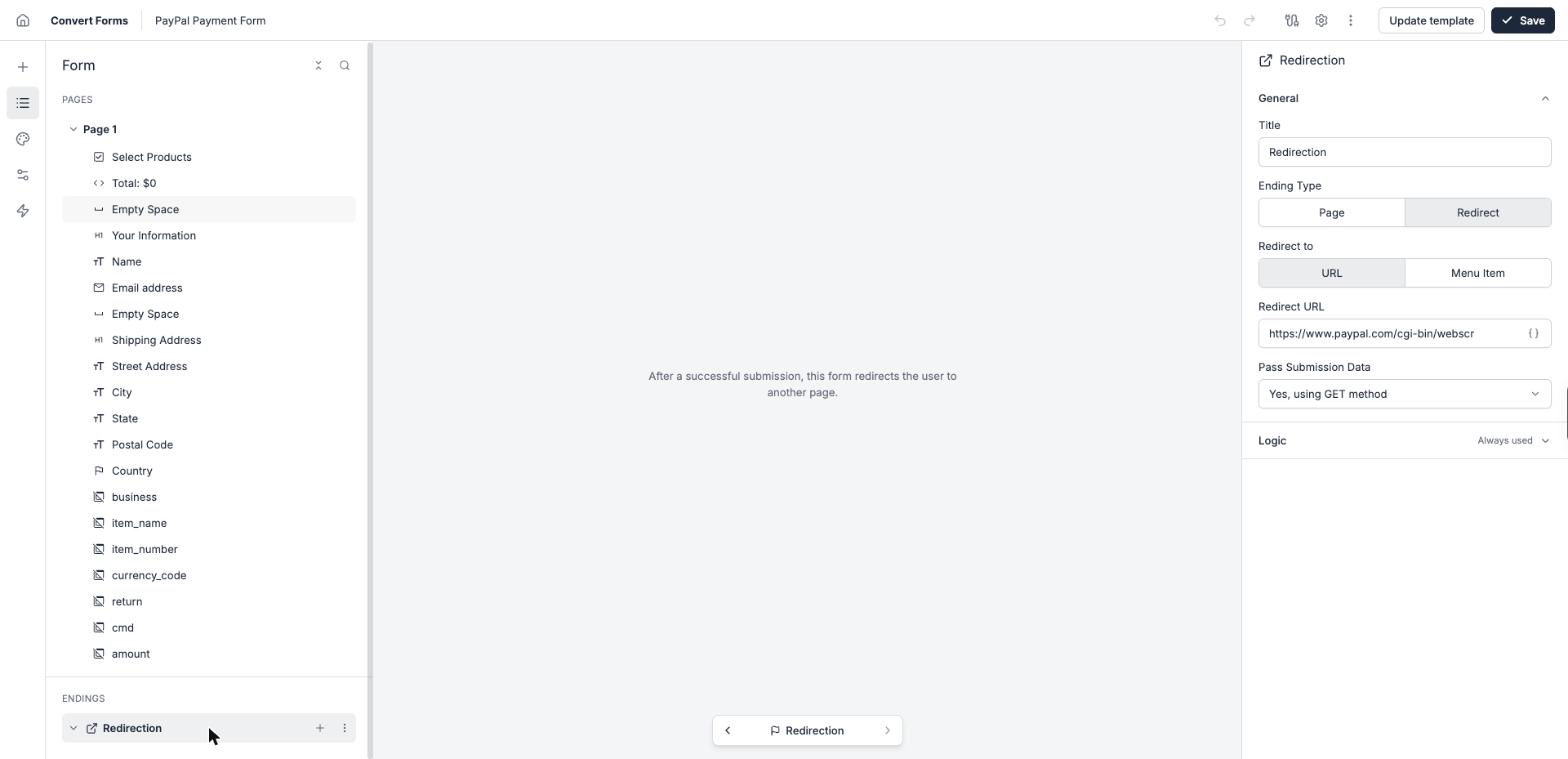
After adding the above fields, your form should look something along these lines:
Your users can now set the donation amount, press the Donate button and after successfully submitting the form, they will be redirected to paypal to send the donation.
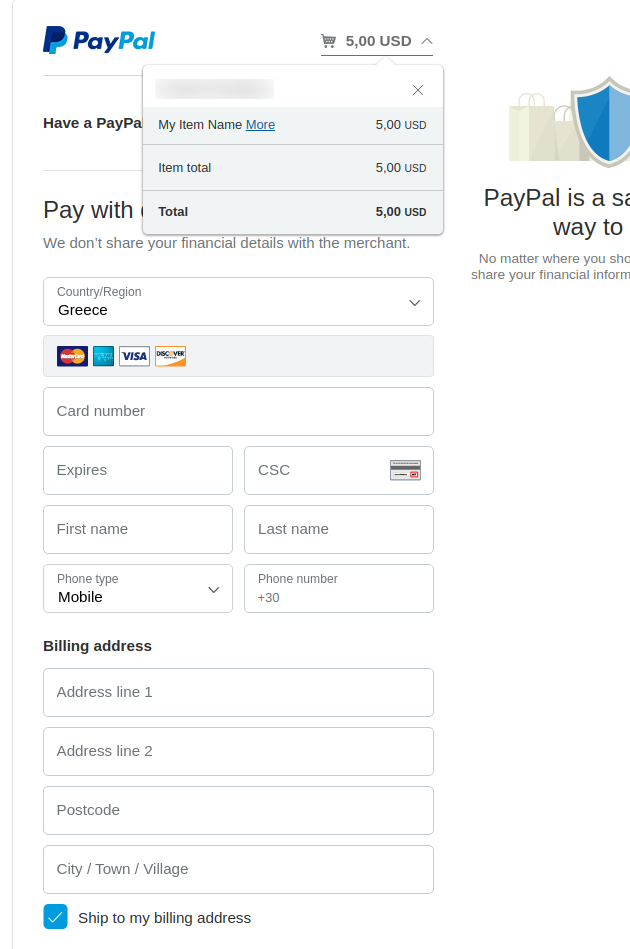
Donation PayPal Redirection:

Payment PayPal Redirection:
Frequently Asked Questions
Can I pre-set the amount of the donation/payment?
You can set your amount field to be a Hidden Field instead of a Textbox or a Number so you can define the amount your donation or payment will have once your users get redirected to PayPal.
| Field Type | Field Name | Field Value |
|---|---|---|
| Hidden | amount | 5 |
Can I calculate the amount based on field values?
Whether you have a simple or a complex calculation, using the Field Calculations you can now pass the calculated total as the amount to your payment or donation.
How can I test my form in PayPal sandbox?
To test your form in PayPal's sandbox, open the ending that redirects to PayPal and set Redirect URL to https://www.sandbox.paypal.com/cgi-bin/webscr instead of the live PayPal URL.
You must also use a sandbox email address in the "business" hidden field.
How can I set the language when redirected to PayPal?
To set the language of PayPal when redirecting the user to make a payment, you will need to add the following Field in your form:
| Field Type | Field Name | Field Value |
|---|---|---|
| Hidden | lc | GR |
You can find a list of Country Codes, here.
How do I fix the error "Things don't appear to be working at the moment. Please try again later"?
This error appears when you're testing your form in a sandbox environment (click here to read more), but you haven't specified a sandbox email address in the "business" hidden field > Default Value.
It also appears when you started from a PayPal template and didn't replace {site.email} in the "business" hidden field with your PayPal business email.
Another reason this error may appear is when you're using Field Calculations in your "amount" field and haven't set Decimal Separator to "Use Dot (.)"
- How to create a PayPal payment form
- How to create a PayPal donation form
- How to create a PayPal form manually
- Shipping cost
- Frequently Asked Questions
- Can I pre-set the amount of the donation/payment?
- Can I calculate the amount based on field values?
- How can I test my form in PayPal sandbox?
- How can I set the language when redirected to PayPal?
- How do I fix the error "Things don't appear to be working at the moment. Please try again later"?


 Rated: