

-
- Managing Form Submissions
- Searching and Filtering Submissions
- Submission Context Tracking
- Customizing Submission Columns
- Editing Submissions
- Deleting Submissions
- Importing Submissions
- Exporting Submissions
- Exporting Submissions with a Webhook URL
- Tracking the User's IP Address
- Tracking the User's Country
- Disable Submission Storage
- Auto-Delete Old Submissions
- Auto-Save Each Submission to a JSON file
- Increment a Count on Each Submission
- Add a Unique ID to Each Submission
-
- Email the Person Who Filled Out the Form
- Send an Email Only When a Checkbox Is Checked
- Attach the Submission PDF to Emails
- Send Email Based on Drop Down Selection
- Send Different Email Content Based on Form Responses
- Set up Auto-Responder Emails
- Styling Emails with CSS
- Sending Plain-Text Alternative Body Emails
- Troubleshooting Email Delivery
- Tracking Sent Emails
- Resending Emails
-
- Browser Autocomplete for Form Fields
- Redirect to a Menu Item After Form Submission
- Show a Form Only to Logged-In Users
- Adding an “Other” Option
- Show or Hide Form Fields Based on User Joomla User Group
- Scroll the Page to the Top When a Long Form is Submitted
- Display Submissions Count for a Specific Form
- Populate Drop Down, Radio Buttons or Checkboxes with a CSV File
- Silently POST Submitted Data to Any API or URL
- Create a Custom Login Form
- Auto-Populate Fields with Article Data
- Add a placeholder text to a Dropdown field
- Create Multilingual Forms in Joomla
- Redirect User to a URL After Form Submission
- Importing and Exporting Forms
- Display Convert Forms in a popup
-
- Does Convert Forms Use Cookies?
- Minimum Time to Submit
- Restrict Form Submissions Based on IP
- Enforcing a Custom Password Policy in Convert Forms
- Add ALTCHA Proof of Work to your Joomla form
- Add Cloudflare Turnstile to your Joomla Form
- Implement the Iubenda Consent Database in Joomla with Convert Forms
- Add Custom Validations to Fields and Forms
- Add Math Captcha to your Form
- Prevent a Field From Saving in the Database
- Add hCaptcha to your Form
- Enable Double Opt-in
- Allow Form Submissions in Specific Date Range
- Ensure a Unique Value is Entered Into a Field
- Block Form Submissions Containing Profanity (Bad Words)
- Block Email Addresses or Email Domains
- Honeypot
- Setting Up Google reCAPTCHA
- Create GDPR Compliant Forms
Add a Unique ID to Each Submission
Each form submission in Convert Forms already has a built-in unique ID. This is a sequential number (e.g., 1, 2, 3…) that serves as the primary key for identifying each entry in the system.
While this built-in ID is perfectly fine for internal use, there are situations where you may want to generate a different type of identifier, one that’s random, less predictable, or formatted differently. For example, you might want to display a custom reference number to users after they submit a form, such as an order confirmation code or a case number. A custom ID can also be useful when syncing data with third-party systems that require a specific token format, or when you don’t want users to guess how many submissions your form has received.
Prefer a sequential counter (1, 2, 3…) over a random code? See Increment a Count on Each Submission.
Add a Hidden Field to Your Form
Follow the steps below to generate a unique reference number for each submission using Convert Forms.
- Log in to your Joomla administrator.
- Go to Components → Convert Forms.
- Click the form you want to edit.
- Go to Fields → Add Field.
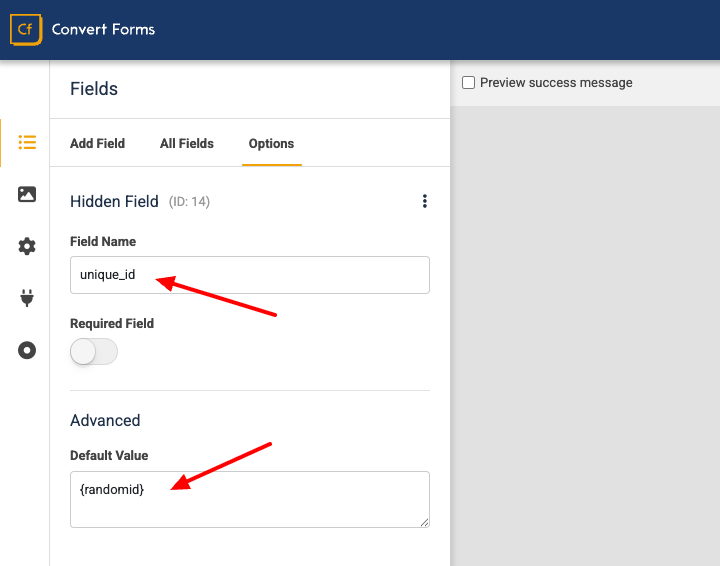
- Add a Hidden field to the form.
- Set the Field Name to
unique_idor something similar. - Set the Default Value to the
{randomid}Smart Tag. The Random ID Smart Tag creates a random 16-character token for each submission and stores it in this hidden field. Example:03bc431d0d605ce4. - Save the form.
Adding the Unique ID to Email Messages
To include the unique ID in your email notifications, use the Smart Tag for the hidden field. If your field is named unique_id, use {field.unique_id}.
This will output the random ID in your email message, making it easy to reference in communications with users or backend workflows.
Frequently Asked Questions
Can I show the unique ID on the thank-you message after submit?
Yes. Drop the {field.unique_id} Smart Tag into the form's confirmation message, exactly as you would in an email, and the ID appears on screen right after the visitor submits.
Can I format the ID, like ORDER-xxxx?
Yes. Combine static text with the Smart Tag in the Default Value field, for example ORDER-{randomid}, and the prefix is stored alongside the random part.
Will the same random ID ever repeat?
In practice, no. The only edge case is aggressive caching serving the same generated value to more than one visitor (see the warning above). If you need a guarantee, pair it with server-side validation.



 Rated: